Sandhill cranes are among the most memorable seasonal visitors to Modoc County. Their rolling calls can carry across open wetlands before the birds come into view, and their tall gray shapes are easy to recognize as they forage in shallow water, cross wet meadows, or circle above the refuge. For travelers planning a late-summer or early-fall road trip, Modoc National Wildlife Refuge offers one of northeastern California’s most accessible places to look for them.
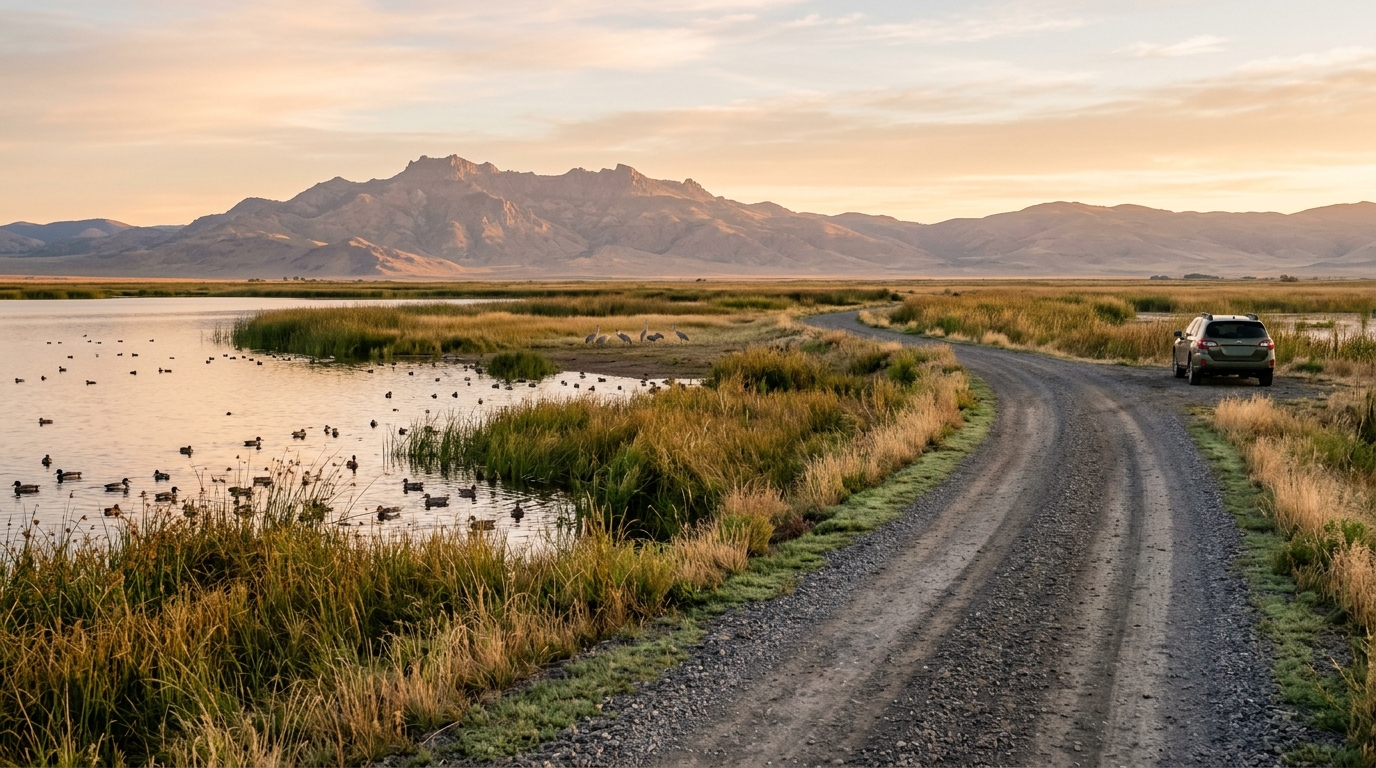
The refuge lies near Alturas along the South Fork of the Pit River, with the Warner Mountains forming a dramatic backdrop. It supports wetlands, wet meadows, open water, agricultural fields, and upland habitat used by cranes, ducks, geese, shorebirds, raptors, mammals, and other wildlife. The experience is quiet and self-guided, so good timing and patient observation matter more than rushing between viewpoints.
Both greater and lesser sandhill cranes pass through during migration. Some greater sandhill cranes remain through summer to establish territories, nest, and raise young called colts. The largest seasonal concentrations are generally associated with spring and late-summer migration, while summer visitors may see family groups at a respectful distance.
This guide explains when to visit, how to use the auto tour and walking trail, what to bring, and how to photograph cranes without disrupting their natural behavior. It can also be combined with the Lava Beds National Monument cave guide or Sáttítla Highlands and Medicine Lake travel guide for a longer northeastern California itinerary.
When and Where to See Sandhill Cranes
Understanding the Spring, Summer, and Fall Seasons
Sandhill crane viewing at Modoc National Wildlife Refuge is not limited to one short weekend. The U.S. Fish and Wildlife Service crane research page advises visitors interested in cranes to plan between March and September. Both greater and lesser sandhill cranes move through during migration, while some greater sandhill cranes stay for the breeding season.
Spring migration builds during March and April. Birds arriving from wintering areas may gather in wet meadows and fields before some continue north. Greater sandhill cranes that remain in Modoc County begin defending territories and may be seen as pairs. Nesting activity generally occurs from April into June, but nests are sensitive locations and should never be approached.
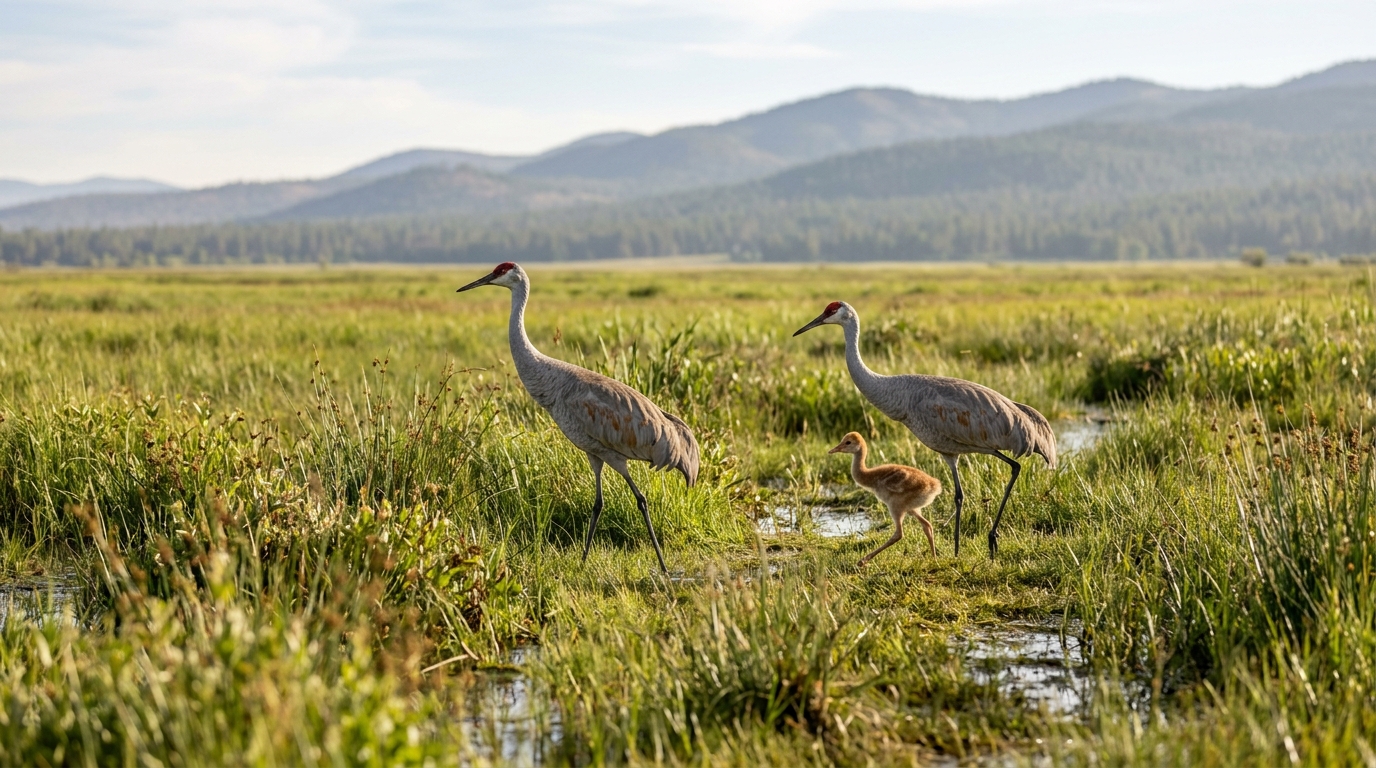
Young cranes usually hatch in June and July. Colts can sometimes be seen from June through August walking beside their parents or feeding in wet habitat. They are vulnerable before they can fly, so a distant sighting through binoculars is better than moving closer for a photograph.
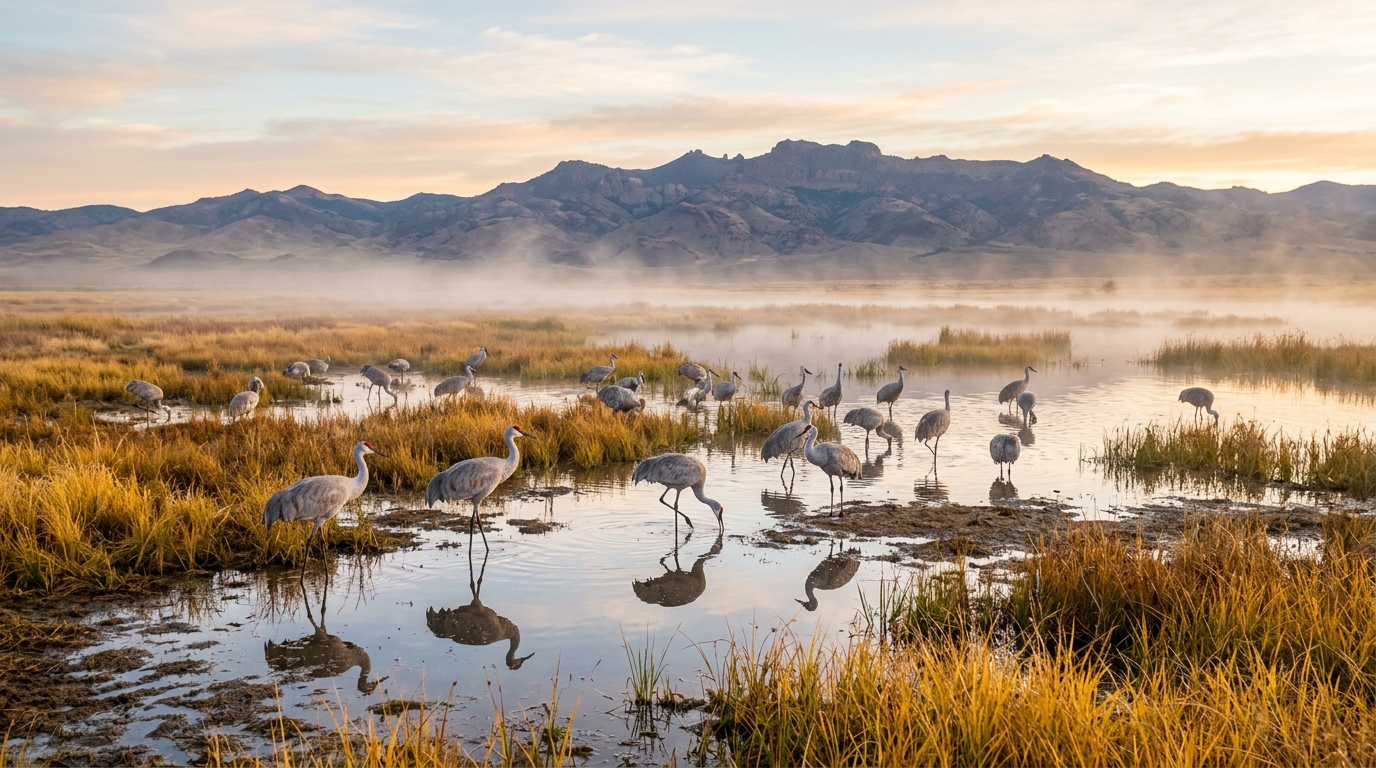
Numbers rise again during August and September as cranes begin their southbound movement. This period pairs well with other Modoc County road-trip stops, but exact timing changes with weather, water, food availability, and broader migration conditions. No specific date can guarantee a large flock.
March–April Versus August–September
Choose March or April for cool conditions, spring movement, and the possibility of seeing newly returned territorial pairs. Be prepared for wind, storms, cold mornings, and muddy edges around wet areas.
Choose August or September for another major migration window, warmer afternoons, and easier road-trip planning. Early mornings can still be cold, while late summer may bring wildfire smoke, heat, or dry conditions. Check local alerts and air quality before making a long drive.
Summer between the migration peaks is best approached as a family-group viewing season rather than a search for the largest flock. Resident greater sandhill cranes and colts may be spread across the landscape, making patience essential.
Using the Auto Tour Route and Wigeon Pond Trail
The refuge’s three-mile auto tour route wraps around Teal Pond and is the simplest way for first-time visitors to explore. It can be traveled by car, bicycle, horseback, or on foot. The route is open from 7:00 a.m. until sunset, and the posted speed limit is 10 mph.
Drive slowly enough to scan field edges, shallow water, ditch banks, and open meadow habitat. Cranes may stand nearly motionless while feeding, making them easy to miss against dry grass. Stop only where permitted, keep the roadway open, and use the vehicle as a viewing blind when birds are nearby.
Near the end of the route, a designated parking area provides access to a paved walking trail in a wetland setting. The Wigeon Pond Trail offers a slower pace and a lower viewing angle than the drive. It is also a good place to listen for crane calls and look for smaller birds.
A Practical Early-Morning Refuge Visit
Arrive shortly after the route opens and allow at least two hours. Start with one slow drive instead of stopping immediately at every bird. Note where cranes, raptors, or larger waterfowl are active, then make a second pass with more focused stops.
After the drive, park at the designated trail area and walk quietly. Carry binoculars, water, a warm layer, sun protection, and a field guide or birding app downloaded for offline use. Keep voices low and avoid sudden movement when birds are close to the route.
Finish at the visitor center if it is open. Headquarters and visitor-center hours are generally Monday through Friday from 7:00 a.m. to 3:30 p.m., except holidays, but occasional changes can occur. Confirm hours before relying on an indoor stop.
After the refuge, continue into Alturas for food and supplies or use the day as the wildlife portion of a broader Modoc County weekend itinerary. Avoid combining the refuge, a long cave visit, and a distant mountain destination in one rushed day.
How to Watch and Photograph Cranes Responsibly
Recognizing Crane Behavior and Other Refuge Wildlife
Sandhill cranes are tall, long-necked birds with broad wings, long legs, gray plumage, and a red crown on adults. Their loud, rattling calls are often the first clue that cranes are nearby. In flight, they hold their necks straight rather than folding them back like herons.
Watch behavior as carefully as appearance. Relaxed cranes may feed steadily, preen, rest, or walk without repeatedly looking toward you. A bird that stops feeding, raises its head, gives alarm calls, moves away, or places itself between an observer and a colt may be reacting to disturbance. Back away or remain inside the vehicle.
The refuge is not only a crane destination. Depending on the season, visitors may encounter snow geese, tundra swans, ducks, shorebirds, hawks, eagles, coyotes, turtles, river otters, and other wetland wildlife. Scanning different habitat layers usually produces a richer visit than focusing on one species.
Binocular and Camera Setup
Binoculars in the 8x or 10x range are practical for most visitors. A spotting scope can help with distant family groups or birds across open water. Avoid walking off the designated route to shorten the viewing distance.
For photography, a telephoto lens is more useful than trying to approach. Use a fast shutter speed for walking or flying birds, support the camera against the vehicle or a monopod, and take short bursts rather than creating continuous shutter noise. Do not use recorded crane calls to attract birds.
Morning and evening light can produce warm color and reflections, but behavior should determine the shot. Leave vegetation, water, and mountain scenery in the composition to show the crane’s habitat instead of producing only tight portraits.
Rules, Pets, Weather, and Access
Stay on the designated auto tour route and walking trail. Most other refuge lands are closed to general public access unless a special event or permit applies. Pets must remain leashed, although leaving a pet at home is often better for quiet wildlife observation.
Pack out trash, do not feed wildlife, and never use a drone over refuge animals. Avoid blocking the road with tripods or open vehicle doors. If several cars gather around a crane family, continue to another viewpoint rather than adding pressure.
The refuge sits at roughly 4,370 feet. Summers are typically hot and dry, winters can be extremely cold, and spring and fall often bring wind and storms. Carry layers even when Alturas feels warm, along with drinking water, sun protection, and suitable footwear.
Before departure, review the official Modoc National Wildlife Refuge visitor information and current rules. Seasonal restrictions may affect particular areas, while office hours and wildlife locations can change.
A crane sighting is never guaranteed, but the refuge rewards people who arrive early, move slowly, and allow the landscape to reveal itself. Plan around March–April or August–September for the strongest chance of seeing larger numbers, or visit in summer to look for greater sandhill crane families from a respectful distance. With binoculars, patience, and responsible behavior, the refuge can become one of the most memorable stops in Modoc County.